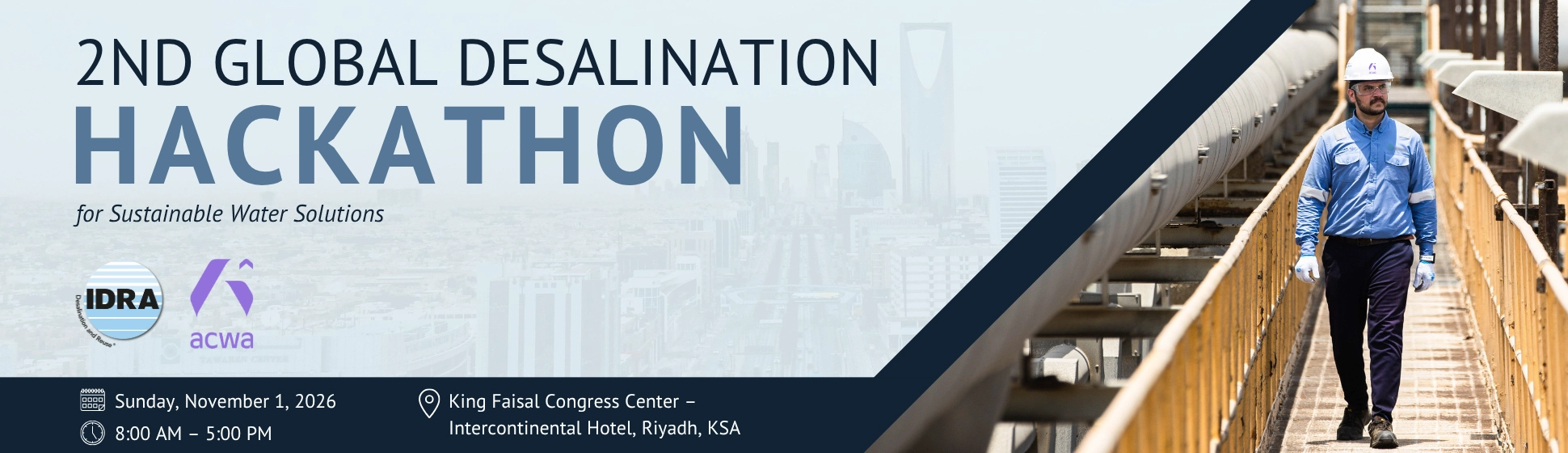
Desalination Hackathon
Invitation to the 2nd Edition of the Global Desalination Hackathon for Sustainable Water Solutions IDRA World Congress 2026
Pre-Congress Workshop Sunday, 1 November 2026, Riyadh-KSA
ACWA in collaboration with IDRA, is pleased to invite you to participate in the 2nd Edition of the Global Desalination Hackathon for Sustainable Water Solutions, hosted as part of the IDRA World Congress 2026 in Riyadh.
Building on the success of the previous edition, this hackathon is designed to bring together high-potential talent and multidisciplinary teams to develop practical, scalable, and technically sound solutions that can move beyond concept stage into real-world application.
Hackathon Theme:
Intelligent Desalination: Innovate for Impact
Challenge Statement:
The plant is equipped with a sophisticated control system that continuously adjusts dynamic setpoints based on predefined process parameters and control logic to ensure stable and efficient operation.
The proposed AI-based solution aims to further enhance this control system by:
- Predicting the optimal operating regime for different plant loading conditions using historical and real-time operational data.
- Providing AI-driven recommendations to the dynamic setpoints, enabling adjustment of key process parameters to achieve the lowest possible SEC.
By integrating AI with the existing control philosophy, the plant can continuously optimize its operation, particularly during partial-load conditions, where significant opportunities for additional energy savings exist.
Participants are free to explore any technical or conceptual pathway that addresses the challenge. Solutions may focus on engineering approaches, operational processes, risk assessment methodologies, workforce management concepts, monitoring approaches, decision-support systems, data-driven models, simulation techniques, or any other practical method capable of delivering measurable value.
The proposed solution should remain practical, scalable, and adaptable across industrial environments such as desalination, power generation, renewable energy, green hydrogen, and construction activities.
Challenge Owner: Rabigh 4
Rabigh 4 (Rawabi) is one of ACWA’s flagship seawater reverse osmosis desalination plants, producing 600 MLD of potable water and supplying approximately 3 million citizens and residents. The plant incorporates cutting-edge RO technology, enabling high operational reliability while achieving one of the lowest Specific Energy Consumption values in the desalination industry.
Background of the Challenge Statement:
Reducing energy consumption is a key objective across the global desalination industry, as it directly improves plant efficiency, lowers operating costs, and reduces environmental impact. The Rabigh 4 Independent Water Project (600 MLD) was designed as one of the world’s most energy-efficient seawater reverse osmosis desalination plants and has consistently achieved a Specific Energy Consumption (SEC) lower than its design target.
Despite this outstanding performance, further optimization opportunities remain, particularly during partial-load operation, when the plant operates below its full production capacity of 600 MLD. Under these operating conditions, the SEC increases slightly compared with full-load operation due to changes in process conditions and equipment operating regimes. Although the plant continues to perform better than its design limits during partial-load operation, additional improvements are achievable.
The key challenge is identifying the optimal operating strategy among numerous process variables and equipment configurations. This is where Artificial Intelligence can provide significant value. By applying advanced data analytics and machine learning techniques to historical and real-time operating data, AI can identify hidden patterns and recommend optimized operating regimes that minimize SEC while maintaining production, water quality, and operational reliability.
Objectives:
The challenge aims to identify AI-based solutions that can:
- Help ACWA predict the optimum operational regime.
- Improve the SEC under different operational loading conditions.
- Support informed decision-making and timely intervention through real-time data analysis.
- Demonstrate creative thinking through engineering, operational, environmental, human, or data-driven perspectives.
- Can be practically deployed within industrial environments and scaled across multiple facilities and geographies.
- Demonstrate a clear pathway from concept development to pilot implementation within industrial operations.
- Possess strong intellectual property, commercialization, and deployment potential.
Hackathon Highlights:
- Participants: Must form teams of up to 5 members.
- Support: Each team will be guided by a mentor, providing expertise, and helping to refine ideas. Also, each team will have intellectual property guidance to further develop their idea.
Participants are expected to design solutions that meet defined technical requirements and reduction targets, with a strong emphasis on feasibility and real-world application.
Hackathon Journey
Date
Ongoing – 2nd October 2026
Phase
Application Phase
details
Teams submit:
- Initial solution concept
- Technical approach
- Expected impact and reduction outcomes
Date
5th– 9th October 2026
Phase
Selection Phase
details
A limited number of teams, up to 10 teams will be shortlisted.
Selection based on:
- Feasibility and technical depth
- Innovation and originality
- Alignment with challenge requirements
- Potential for development and patentability
Please note only shortlisted teams will be contacted for the next stage
Date
12th – 30th October 2026
Phase
Pre-Hackathon Development
details
Shortlisted teams will gain access to:
- Expert-led workshops to refine and strengthen their solutions
- Dedicated IP sessions with a specialized agency to:
-Assess patentability
-Structure ideas for protecion
-Enhance innovation positioning
This phase ensures that teams arrive at the hackathon with a solid foundation, ready to build further.
Date
1st November 2026
Phase
Hackathon Day
details
First Half:
- Mentorship and final development
- Technical refinement and pitch preparation
Second Half:
- Final presentations before an expert panel
- Evaluation based on innovation, feasibility, and impact
ACWA’s Talent Acquisition team may also be present during the hackathon to engage with participants and identify promising talent.
Date
5th November 2026
Phase
Awards Day
details
Outcomes for the Winning Team:
- Recognition and Awards: Gain acknowledgment for your innovative solutions.
- Networking Opportunities: Connect with leaders in the field.
- Post-Hackathon Evaluation: The winning solution will be assessed by Rabigh 4, the ACWA Water team, and technical stakeholders for its technical feasibility, business value, and scalability.
- Intellectual Property Opportunities: Explore patentability and intellectual property development for eligible solutions.
- Pilot Implementation Potential: High-potential solutions may be considered for further development and pilot deployment within Rabigh 4 operations.
- Pathway to Scale: Successful solutions may be evaluated for broader deployment across ACWA’s desalination, water treatment, and other relevant operational facilities.
Additional Opportunities
- Solutions demonstrating strong novelty and patentability may be advanced for patent exploration and filing, even if not selected as winners for further development.
Registration Details:
We are currently inviting:
- Teams interested in participating in the hackathon
Please register using the following link: Acwa and IDRA 2nd Global Desalination Hackathon for Sustainable Water – Nov 2026 – Fill out form
- Subject Matter Experts who would like to contribute through mentorship and technical guidance
Please send an email to [email protected] with your details and bio.
For More Information: Please contact [email protected]